
Send space photos before personal details
How To Prepare Home Safety Photos For Quotes helps you decide which home details, limits, and provider questions matter before a senior home safety quote request.
For an early home safety quote conversation, start with wide photos of the route or room, close-ups of surfaces and thresholds, and simple measurements. Avoid faces, medical papers, financial documents, and private records unless a qualified professional specifically needs them later.
What matters most
- Good for: Preparing a clearer request before you send photos or contact details.
- Have ready: Wide photos, close-up photos, rough measurements, timing, and privacy-sensitive details to avoid.
- Next step: Share enough context for fit, then leave final decisions for an in-home review.
- Use the page as planning support, not as a quote, inspection, medical decision, code decision, or provider verification.
- Variations and edge cases depend on the home layout, timing, local rules, product fit, and the person using the space.
When to pause and get local help
- If the project affects health, transfer safety, structure, electrical work, plumbing, permits, or urgent access, then treat this page as preparation and get qualified local review.
- If photos, measurements, timing, or location are missing, then the next step is to collect details before comparing quotes.
- If a provider, sponsor, badge, directory label, or public-source listing appears, then verify license, insurance, written terms, contract, and local fit yourself.
How to read the main choices
| Situation | What to collect | What it means |
|---|---|---|
| Quote-ready request | Photos, rough measurements, timing, location, and budget band are available. | A provider can decide whether the request fits before an in-home review. |
| Planning-only request | Project type, measurements, or home conditions are still unclear. | Use the checklist and collect more details before comparing providers. |
| Safety or suitability concern | Medical, structural, electrical, plumbing, permit, or urgent fall-risk questions are involved. | Confirm the scope with a qualified local professional before relying on a plan. |
Bring these details into the conversation
- Name the main route, room, support point, or project type that creates the daily problem.
- Collect wide photos, close-up photos, rough measurements, timeline, city and state, and any access limits.
- Separate quick fixes from quote-worthy work, then ask what could change after an in-home review.
- Avoid sending medical records, financial documents, Social Security numbers, passwords, or unnecessary private details.
If two paths both seem plausible
If two options seem possible, such as a ramp versus a stairlift or grab bars versus a larger bathroom change, then start with the daily movement problem, collect the basic measurements, and ask a qualified provider which variation fits the home before treating any range as a real quote.
Start with details the first conversation can use
You do not need a complete diagnosis. You need enough detail for a qualified provider to understand the home, the timing, and what could change after an in-home review.
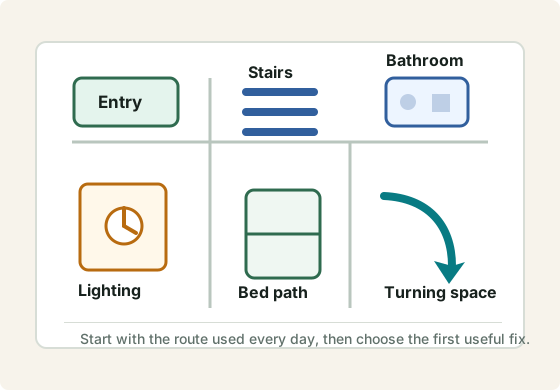
Entry, stairs, bedroom path, bathroom, kitchen, and lighting.
Wide room view, close-up of the friction point, and measurement context.
Urgent safe access first, durable upgrades second, optional polish last.
Where this usually connects
If this page is close to your situation, Prepare a request can help with the immediate next step, while Printable photo checklist gives useful context before you compare provider answers.
This guide creates original request-quality value without claiming firsthand project inspection.
Stairs and entries
Capture the full staircase or entry from top, bottom, and side angles. Include nearby outlet, landing, doorway, and any turns.
Bathrooms
Capture the tub or shower entry, toilet area, wall surfaces, doorway, floor, and any obstacles. Avoid including private medical documents.
Measurements
Pair photos with approximate rise, width, number of steps, and room dimensions when safe to measure.
Before you request quotes
- Top and bottom views
- Side view
- Close-up of surface condition
- Door and landing context
- No private paperwork or faces unless necessary
Ask questions that reveal the real scope
These questions help you compare answers without relying on memory after several calls.
- What is included in the first written scope, and what commonly becomes extra after inspection?
- Which details do you need from photos or measurements before deciding whether this is a fit?
- Who performs the work, who supervises it, and who handles service or written service terms questions later?
- What would make this project slower, more expensive, or inappropriate for this home?
What this page cannot decide for you
- A planning guide cannot inspect the home, confirm local code, verify provider quality, or judge medical suitability.
- Treat cost ranges and decision tables as preparation tools, not final prices or professional advice.
- Before hiring, verify licenses, insurance, permits, contracts, written service terms, and local requirements with the provider or authority that applies to the actual scope.